And So Many Holidays!
 |
| One of Many Altars for Dia de Muertos, Day of the Dead |
Mexico celebrates many more holidays than the countries north of the
border. Holidays are festive times, right? So, why is this something that can
create culture shock? Let me try to explain with some examples.
Many Holidays are
Unique to Mexican Culture
Dia de Muertos, a very
festive time in Mexico, means literally, Day of the Dead. A festival that
revolves around death? I didn’t understand it for years.
The celebrations last for several
days, from October 31 through November 2. This is a time when families and
friends celebrate, inviting the souls of those who have died to join them on
earth. A large part of this celebration takes place in the cemetery at the
loved one’s grave. Food, alcohol, candles, flowers, and other gifts are placed
on the grave, offered to bring the soul to earth. The family members will have
a picnic at the grave, eating a meal and drinking beer. The belief is that their
departed love ones’ souls join them to share this meal. This was difficult for
me to understand when we first started traveling to Mexico. In the United
States, in non-Hispanic cultures, when we visit a grave-site, we feel sadness at the loss of our loved
ones, certainly not a festive joy.
After living in this beautiful
country for some time now, I have come to see this festival as a celebration of
life, a time to remember and honor the people who have passed from this earth.
The town plazas become a place where many colorful alters are built with flowers,
food offerings, candles, sand and rocks, personal articles, and photographs,
each honoring a deceased person. Music and entertainment fill the downtown with
people mingling and strolling through the path between alters, admiring the
artwork of each memorial, then moving on to enjoy the festivities. Later in the
night, a long line of quiet Mexicans can be seen walking from the plaza, through
downtown and neighborhoods, to the cemetery, each carrying a lighted candle.
When first
experienced, it appears that Dia de Muertos revolves around death. Now I see that this
celebration is a healthy way to remember the life of departed loved ones.
 |
| Parade for Dia del Niño (Day of the Child) |
Dia del Niño, Day of the Child,
is also unique to Mexican culture, and a very big deal in the town we live in. The main street into downtown is
closed for hours for a parade and it seems the whole town turns out to watch
the children dressed in costumes, riding in floats that cruise the streets around the
plaza. It is a lively, happy festival with the crowd filling the plaza and
spilling into the streets. Two young children dressed as the King and Queen of
the day ride in their own fancy float. They help throw treats including balls
and hula hoops to children and adults alike.
I am impressed with
how much attention and love the children receive in this culture. To set aside
an entire day to honor the children and to make them feel special is unlike
anything I’ve seen in the United States. It is a joy to watch. It is also wise
to plan your day so as to avoid driving through town, taking laundry to the lavandería,
or shopping for groceries while the festivities are happening, at least in our
town. We soon learned that the roads
will be blocked for hours on Dia del Niño,
so we might as well find a taco stand, settle in for some fish tacos and a drink,
and enjoy the show!
 |
| Our Lady of Guadalupe Festivities Last for Days |
Holiday Noise Can Be
Disturbing & Can Last for Days
In addition to all of the fun things such as parades, bands playing
music in the plaza, residents and tourists dancing around the band, cowboys
riding dancing horses, and children in costumes, there is an amazing amount of
noise that reverberates across the town during holidays. Some holidays are
accompanied by more noise than others, but for me, the holiday that was the
most shocking was Our Lady of Guadalupe.
The first year we lived there, I was startled awake by cannons going off
downtown at 5:00AM to call the Catholics to church. Bella was barking and I
wondered what the sound was, so loud we heard it clearly a half-mile away. I
had just calmed her down and fallen back asleep, when the next cannon went off
at 5:30AM. Another round of barking and falling asleep only to be jolted awake at 6:00 by a third cannon shot. By then, Jon and I realized it must be cannons
calling the Catholics to come to church for a service. That day, I asked around
town to find out that each day during the week leading up to Our Lady of Guadalupe
on December 12 begins with cannons and church bells! Each evening ends with
fireworks.
All of this early morning and late-night noise was culture shock at
first. By the fifth or sixth morning, I didn’t hear the cannons explode at all.
I slept right through the sounds, and so did Bella.
 |
| Preparing the Lady of Guadalupe Float for our Barrio |
The evening festivities for Our
Lady of Guadalupe are colorful and entertaining, including children dressed
in traditional costumes, dancing to the beat of drums, proceeding through the
closed streets downtown. Each night a different float is included in the parade
around the plaza. In our town, each of the barrios
(neighborhoods) is assigned one evening of the festival to display their float.
We had just moved into our new casita
when one evening we noticed a crowd in front of our house, gathered around a
large flatbed truck. As I watched, the children and adults chatted and worked
together to create our neighborhood’s float on the back of the truck. Many were
working to decorate the truck, transforming it into a beautiful float. Women
were dressing the children as angels, wise men, the Virgin Mary, and other
characters to fulfill the theme of their float. Excitement filled the air as
the costumed children were lifted onto the float and helped into their assigned
positions. It was fun to watch, a real community project. When the parade
organizer gave the order, the float rolled away, driving toward the downtown
plaza with a crowd of proud parents, grandparents, siblings, and neighbors
walking along behind.
Then the fireworks begin around 10:00PM. They can be heard all over
town, startling us awake again, if we decided to go to bed early that night.
Bella barks furiously. Other dogs can be heard barking in the neighborhood. When
it finally quiets, I think, “Best if we get some sleep because this will start
all over again at 5:00AM tomorrow.
Holidays with Loud Music All Night
 |
| A Wedding Procession through San Miguel de Allende |
There are many other holidays when fireworks and cannons are shot into
the air in the evening, and then loud music and the fiesta begins, many times lasting until dawn.
Often, we don’t even know what the holiday is. Sometimes there are fireworks
after a wedding in our town. In San Miguel de Allende we saw a parade through
town for a wedding, the bride, groom and many guests led by tall caricatures of
a bride and groom, other guests riding in fancy horse-drawn carts through the
steep cobblestone roads. It was enjoyable to sit at a sidewalk café and watch
the happy people stroll down the narrow streets, drinking champagne, and
toasting the new couple. What a fun, lively way to celebrate, so different from
any I’ve seen north of the border.
 |
| Musicians in the Plaza May Play Late into the Night |
Yet, we know the parade through town is just
the beginning of the fiesta. We’re always glad we live in the quieter outskirts
of town, far from the venues where the rest of the party occurs, with a band, disc jockey, or recorded music playing loudly through large speakers, and the guests enjoying elaborate
meals, limitless drinks, and dancing until the early hours of morning. Once I
went to the plaza at 6:00 AM to see how many people were still partying to the
music continuing to blare from the speakers. That’s when I learned that just because the
guests have all gone home doesn’t mean the music will be turned off.
In addition to the holidays for
saints and other church traditions, there are parades and celebrations in the
streets for Mexican Revolution Day
on November 20th. Emiliano
Zapata's Birthday August 8, provides another reason for boisterous, noisy
celebration, as he was a leading figure in the Mexican Revolution. Día
de la Independencia, Independence Day in Mexico, celebrates the “cry of
independence” on September 16. The “bombs”, cannon booms, go off frequently for
anything having to do with Revolutions and Independence.
There are also large parties for Quinceañeras (coming out at a 15-years
old girl’s birthday), smaller, yet elaborate baby showers, and fancy birthday
parties for young children that morph into loud music, drinking, and dancing
late into the evening. The loud music can be heard blocks away and may last
until 5:00AM. The Mexican people love their fiestas and know how to stretch
them out and extend their fun!
Those of us who have moved to Mexico to
enjoy all of its benefits must learn to adapt to the differences. Ear plugs are
a necessity, sometimes even sound-cancelling headsets.
Holidays Cause Delays
 |
| Holidays Mean Fun with Friends and Family in the Plaza |
Purchasing our home in Mexico was
our biggest lesson in patience, the time when we learned that businesses,
banks, and government agencies move slowly as a manner of course, “On Mexican
Time”. But throw in a few holidays and the delay may be extended for months.
Getting upset about the delay doesn’t make anything move faster, it just leaves
you more frustrated. So, we learned to wait patiently.
The time from our offer to buy our
house in late July, 2015, until the contract was compiled by the Notario (Notary) and agreed upon and
signed by all parties was about three weeks. I don’t think there were any major
Mexican holidays during that time, things just take time, so by then it was
mid-August. An inspection by a building contractor was done and the report
prepared, which we accepted by the end of August. At that time, the Title
Company became involved to handle the escrow account and transfer of money,
with form completion occurring over the next month. They were finally ready for
our first deposit of funds at the end of September, two months after we had
made an offer on the house. Our contract stated that the sale would close by
November 10, 2015, but allowed for an extra ten days in case of banking or
other business delays. With Dia de
Muertos the first of November, which
should be called the DAYS of the Dead because it can last for up to a week, the
sale closed on the very last day of the deadline, November 20, but only because we insisted. November 20th is Mexican Revolution Day and everyone would have rather postponed the signing of our documents another day or two so they could go to the celebration.
 |
| Everything Stops for Parades and Festivals |
But, what about getting the
recorded deed? Well, allowing for many
upcoming holidays, including Our Lady of Guadalupe, Christmas, New Years, Dia de Niño, Revolution Day, Semana Santa, Easter, and the week after
Easter, we finally received our recorded deed over six months later, in May,
2016. That was a lesson in patience!
I’m glad we hadn’t
decided to build our home in Mexico. I hear the delays waiting for masons,
plumbers/electricians, painters, roofers, and other subcontractors can really
try the patience of a gringo from north of the border! Until you learn the
cultural difference about setting priorities, living on Mexican time can be
very frustrating.
 |
| Terry Gets in the Holiday Spirit with La Catrina |
What we’ve learned is that maybe
the Mexican Nationals have their priorities straight—family and fun come first.
Work can wait—it will always be there. I enjoy living “On Mexican Time” now
that I’ve adjusted to it. In fact, when we return to the United States for a
few months, we wonder why everyone is in such a hurry, rushing to work, rushing
home, stuck in rush-hour traffic. How did we ever live like that, and for as
long as we did? Life is healthier, more enjoyable, when the pace is slowed down,
and we are comfortable with that slower pace.
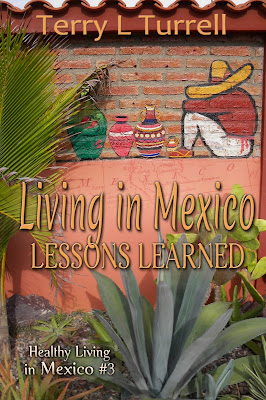
Read more about culture shock and the fun of moving to Mexico in this eBook, "Living in Mexico, Lessons Learned: Healthy Living in Mexico #3". Have you read the other four books in the series?
 |
| Available on Amazon Worldwide! |
If you haven't read "Healthy Living in Mexico #1 and #2", here are the links on Amazon.com. Remember these are also available on Amazon.ca, Amazon.mx, and Amazon worldwide!
Healthy Living and Traveling in Mexico: A Search for Sunshine, Sassy Exercise, Savory Food and a Simpler Life Kindle Edition
 |
| Healthy Living in Mexico eBook #1 |
Retirement Before the Age of 59: Healthy Living in Mexico #2 Kindle Edition
 |
| Healthy Living in Mexico #2 |
To sign up for my "Healthy Living and Traveling in Mexico Monthly Newsletter", click HERE